
Why 98% accurate AI notes still contain errors
In short
- At 2% per claim, a 200-claim note set is 98.2% likely to contain an error.
- Spot-checking 10% of it catches that error only 34.6% of the time.
- Verifying a cited claim takes seconds; an uncited one takes minutes.
- Across 200 claims that gap is 50 minutes against 5 hours.
Accuracy claims about generated content are usually quoted per item. A model gets 98% of medical facts right; a summariser preserves 99% of the source. Those sound like the end of the conversation.
They are the beginning of it, because you do not consume one claim. You consume a set, and sets compound.
The arithmetic
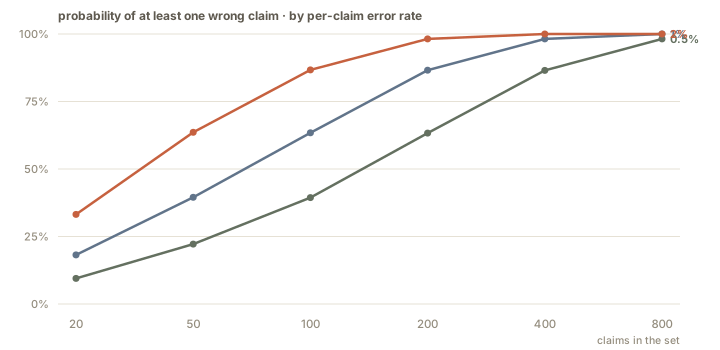
If each claim is independently wrong with probability p, a set of N claims is clean with probability (1 − p)^N. The chance that at least one thing in it is wrong is 1 − (1 − p)^N.
That expression moves faster than intuition expects.
| Claims | 0.5% error | 1% | 2% |
|---|---|---|---|
| 20 | 9.5% | 18.2% | 33.2% |
| 50 | 22.2% | 39.5% | 63.6% |
| 100 | 39.4% | 63.4% | 86.7% |
| 200 | 63.3% | 86.6% | 98.2% |
| 400 | 86.5% | 98.2% | ~100% |
| 800 | 98.2% | ~100% | ~100% |
A single lecture converted to notes is comfortably 200 claims. At a 2% per-claim error rate — which would be an impressive figure to advertise — that note set is 98.2% likely to contain at least one wrong statement, and contains four on average.
Even at 0.5%, a semester’s worth of material at 800 claims is 98.2% likely to contain an error.
The uncomfortable conclusion: for any realistic error rate and any realistic volume, the question is not whether there is something wrong in your notes. It is which claim it is, and whether you will meet it before the exam or during it.
Spot-checking does not work
The obvious response is to check a sample. We ran that too, on a 200-claim set with four bad claims in it.
| Claims checked | Share of the set | Chance of catching one |
|---|---|---|
| 5 | 2% | 9.7% |
| 10 | 5% | 18.7% |
| 20 | 10% | 34.6% |
| 40 | 20% | 59.4% |
| 80 | 40% | 87.3% |
Checking a tenth of your notes catches an error about a third of the time. To get past even odds you have to check a fifth. Sampling is not a defence against a small number of errors hidden in a large set — the errors are rare, which is exactly what makes them hard to sample.
You cannot spot-check your way to confidence. You can only make checking cheap enough that you do it when it counts.
Which is where provenance comes in
The realistic move is not to verify everything in advance. It is to verify the claim in front of you, at the moment it matters — when it contradicts something, when it looks surprising, when you are about to build on it.
That is entirely a question of cost. Checking a claim that carries a page reference is a lookup: jump to the slide, read it, confirm. Call it fifteen seconds. Checking a claim with no provenance is a search — which lecture was this, which slide, did it come from the deck at all or from the model’s own knowledge. Call it ninety.
| Claims | With citations | Without |
|---|---|---|
| 50 | 12.5 min | 75 min |
| 200 | 50 min | 5 hours |
| 800 | 3.3 hours | 20 hours |
Six times the cost, at every scale. But the multiplier understates it, because 90 seconds is past the threshold where people simply stop bothering. A fifteen-second check gets done mid-revision. A ninety-second one gets deferred, and then not done.
An uncited claim is not merely more expensive to verify. It is functionally unverifiable, because nobody pays that cost two hundred times.
What this shapes
This is the reasoning behind how Notes is built. It reformats your lecture material without altering the claims, and it keeps the page reference attached to each one — so a statement that looks wrong can be checked against the slide it came from in seconds.
That constraint costs something. Notes that stay faithful to a deck cannot silently correct a lecturer’s oversimplification, and cannot add the useful context a general model could supply. We think that is the right trade: a note you can check against its source is worth more than a note that is probably slightly better and entirely unauditable.
Research applies the same logic to literature — the report carries its references, and runs citation-integrity checks, because a cited claim whose citation does not support it is worse than an uncited one. Deep Search lists the pages it actually retrieved from, for the same reason.
None of this makes the error rate zero. Nothing makes the error rate zero. It makes the errors findable, which given the compounding arithmetic above is the only property that scales.
Limits of this analysis
The independence assumption is the weak point. Real errors cluster — a model that misunderstands one part of a mechanism tends to get several related claims wrong together. Clustering means fewer independent errors than the binomial suggests, so our compounding figures are somewhat pessimistic, while making each error more damaging because it corrupts a whole topic rather than one fact.
The 15-second and 90-second figures are estimates, not measurements. The ratio matters more than the absolute values, and the ratio is robust: a targeted lookup is roughly an order of magnitude faster than an open search.
We also treat all claims as equally consequential. They are not. Getting a receptor subtype wrong matters more than a date, and a sensible verification strategy weights toward the load-bearing claims — which is far easier to do when each one tells you where it came from.
Analysis: binomial compounding and hypergeometric sampling, closed form. Verification-cost estimates stated above. Code in research/source-fidelity.