
USMLE
What USMLE practises
Section titled “What USMLE practises”The USMLE agent creates clinical vignettes that test application rather than simple phrase matching. You can work from a topic, learning objectives or your own teaching material.
How a question is built
Section titled “How a question is built”- Select the tested concept. The agent chooses a decision, mechanism or diagnosis that can support one best answer.
- Construct the vignette. Clinical details are added only when they help the reasoning or create a useful distinction.
- Align the lead-in and options. Every option must be the same kind of answer and respond grammatically to the question.
- Create plausible distractors. Incorrect choices represent realistic misconceptions or nearby diagnoses, not random noise.
- Solve and quality-check separately. A second pass checks physiological consistency, one-best-answer status, option leakage and the explanation.
- Shuffle and deliver. Option order is normalised before the question reaches the examination.
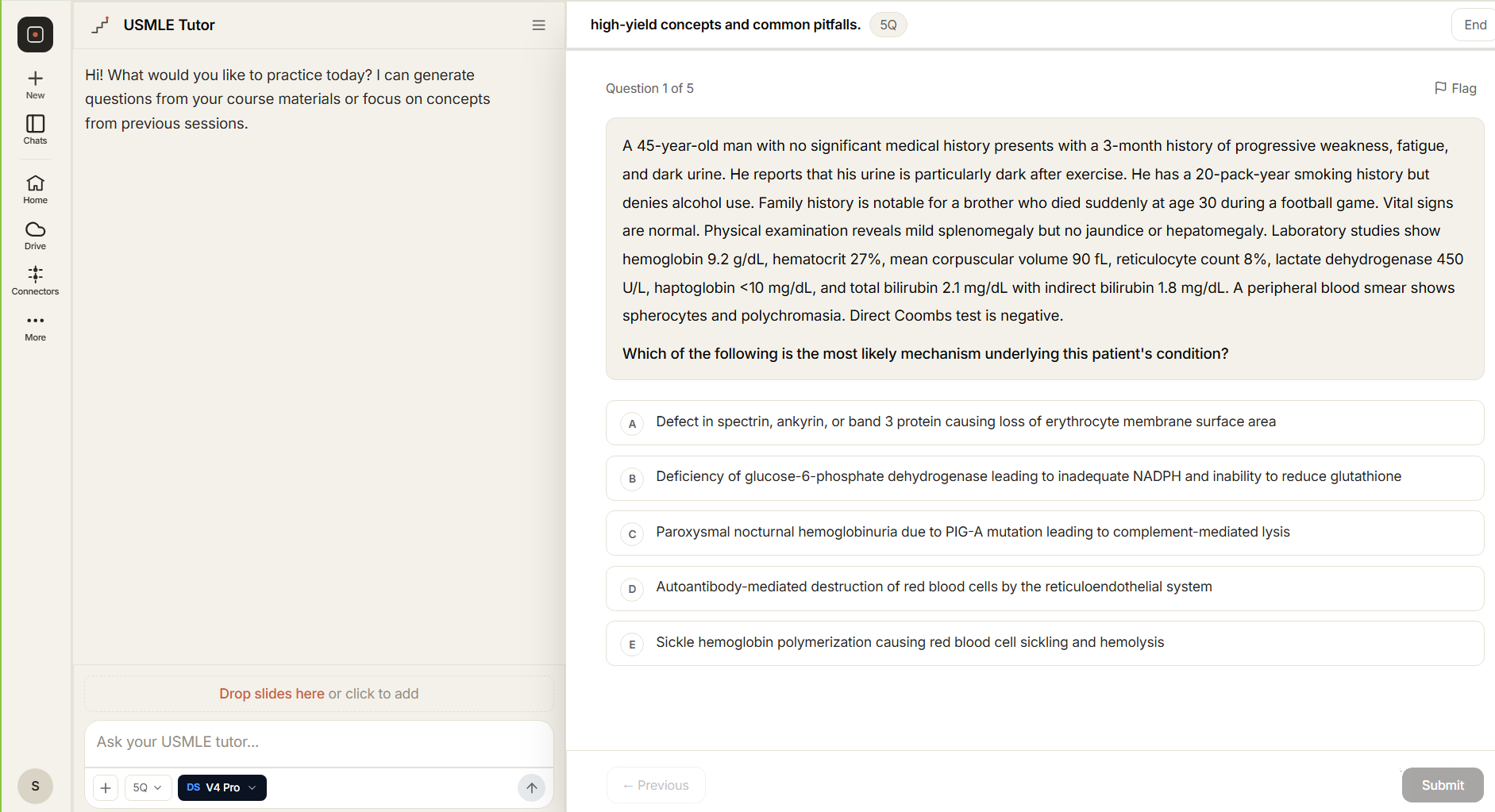 Question generation and quality control are separate passes.
After you answer
Section titled “After you answer”Feedback includes the reasoning path, the decisive findings and the error behind important distractors. A high score does not validate clinical competence; the agent is for study and should not be used for patient-care decisions.