
When to start revising for an exam

In short
- Start twelve weeks out and your worst day is 60 reviews — about nine minutes.
- Start one week out and your worst day is all 800 — about two hours.
- Retention a month after the exam falls from 86% to 76%.
- Late starts fail on peak load long before they fail on knowledge.
The advice to “start early” is the least actionable sentence in medical education. Everyone agrees with it. Nobody can tell you what it is worth, which makes it easy to defer for one more week, and then another.
So we measured what a week of delay actually costs. The answer is not really about how much you know. It is about how much work lands on you in a single day, and the curve is much steeper than we expected.
The setup
Same block as our cramming experiment: 800 concepts, an exam twelve weeks out, FSRS-5 with published parameters, eight runs per condition.
The only variable is when the student begins. We ran start dates from twelve weeks before the exam down to one week before. In every condition the student does the same sensible thing: work through the material at a steady rate, and review any concept whose retrievability has decayed to 90%.
Then we recorded three things — the worst single day in the whole run-up, the total reviews required, and retention thirty days after the exam.
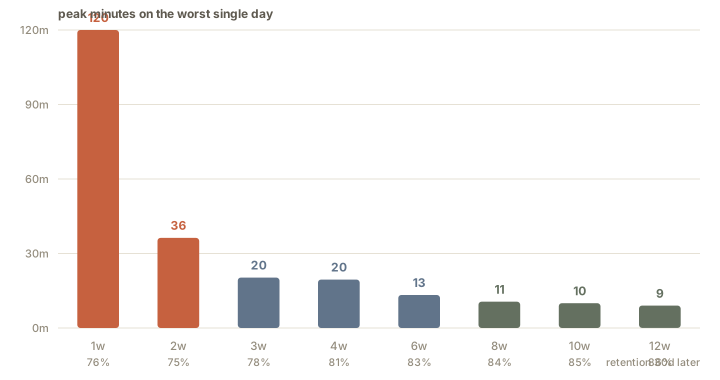
The numbers
| Started | Worst day | Total reviews | Retention 30 days later |
|---|---|---|---|
| 12 weeks | 60 reviews · 9 min | 3,212 | 86.0% |
| 10 weeks | 66 reviews · 10 min | 2,991 | 84.8% |
| 8 weeks | 70 reviews · 11 min | 2,738 | 83.5% |
| 6 weeks | 88 reviews · 13 min | 2,561 | 82.9% |
| 4 weeks | 129 reviews · 20 min | 2,288 | 81.0% |
| 3 weeks | 135 reviews · 20 min | 2,044 | 78.2% |
| 2 weeks | 241 reviews · 36 min | 1,779 | 75.4% |
| 1 week | 800 reviews · 120 min | 1,693 | 76.1% |
Read the first column downward. From twelve weeks to four, the worst day roughly doubles — from nine minutes to twenty. Unpleasant, survivable. Between four weeks and one, it goes up by a factor of six.
The shape is the finding. There is no gentle penalty that scales with lateness. There is a broad, forgiving region, and then a wall.
Why the wall exists
Two effects multiply.
The obvious one is that the same 800 concepts have to be introduced in less time. Compress intake into seven days and you are meeting 114 new concepts a day before any review has happened.
The second is the one people miss. Every concept you learn generates its own review schedule — roughly one review after a day, another after three, another after a week. Learn them spread out and those schedules interleave, so each day’s load is a thin slice of many different cohorts. Learn them all at once and the schedules stack: every concept comes due on the same day, because they all started on the same day.
Spacing your intake does not just spread the learning. It de-synchronises the reviews, which is what keeps any individual day survivable.
A late start does not make the work harder. It makes it arrive all at once.
The interesting anomaly
Look at the last row. Starting one week out produced slightly better thirty-day retention than starting two weeks out — 76.1% against 75.4%.
That is not a bug, and it is not a result we would build advice on. It is the cramming effect reappearing: at one week, everything was touched very recently and repeatedly, so it is all still warm a month later. It comes at the cost of a 120-minute day and a stability profile that collapses over the following months.
We are flagging it because it would have been easy to leave out, and the honest version of a result includes the row that complicates the story.
Total work falls, which is the trap
The middle column runs the other way: the twelve-week student does 3,212 reviews and the one-week student does 1,693. Starting early costs almost twice as much total work.
This is real, and it is why “start early” feels like bad advice to a student who is already overloaded. What you are buying with that extra work is threefold: a peak day of nine minutes instead of two hours, ten points of durable retention, and — the part that does not fit in a table — the ability to be ill for three days in week six without the plan collapsing.
The one-week plan has no slack at all. Miss its single 120-minute day and there is no later day to absorb the overflow.
What we do about it
The scheduling here is not hard, but it is fiddly in exactly the way people abandon. You need to know how many concepts are in the block, how many days remain, and how to phase the intake so review load stays flat rather than spiky. Doing that by hand, in advance, for a block you have not yet read, is not realistic.
Planning builds the schedule from your exam date and the concepts actually due, and Forgetting handles the daily question of what has crossed the threshold. Between them the flat-load plan becomes the default rather than something requiring a spreadsheet and unusual discipline.
If you take one number from this: the difference between starting twelve weeks out and four weeks out is about eleven minutes on your worst day. That is a much smaller price than most students assume they are being asked to pay.
Limits of the model
Simulations of a memory model, not measurements of students. The nine-seconds-per-review figure is a reasonable average for recall-style items but will understate anything requiring working through a clinical vignette.
The simulated student is also perfectly consistent — they never miss a day, never lose motivation in week seven, and learn every concept correctly the first time. Real study is lumpier, and every source of lumpiness makes early starting more valuable, not less, because slack is the thing a late start does not have.
Finally, 800 concepts over twelve weeks is one particular shape. A shorter block or denser material moves the wall, but does not remove it.
Model: FSRS-5, default published parameters. 800 concepts, 84-day horizon, 8 runs per start date, target retention 90%, 9 seconds per review.